
Welcome to SUN HYPE 2026!
During this event, our project leaders will guide small groups of early stage researchers in addressing challenging problems, proposed by them, that are of great relevance and interest to the research community. We hope that our participants will deepen their understanding of the state of the art, acquire new numerical techniques, actively contribute to the development of emerging research directions, and strengthen their professional connections within a solid and collaborative network.
Topics
Numerical Analysis, High-order numerical methods, Structure-preserving techniques, Exascale computing, Hyperbolic equations, Modeling and simulation, Mesh generation and optimization, Astrophysical applications ...
Where
Chania & Technical University of Crete, Greece
When
21-26 of June, 2026
Venue: Chania & Technical University of Crete
Greece
A bus will pick up participants in Chania and bring them to the Technical University of Crete and viceversa.
During their free time, participants will have the opportunity to join organized seaside excursions.
Program
Official schedule, social activities, and daily logistics for SunHype participants.
🍹 Registration & Welcome Reception
The opening will take place at the Chania Sailing Club Neorio Moro, which is located in a beautiful historical building on the harbor of Chania. It includes a light dinner and drinks by the sunset.
- When: Sunday Evening, June 21st.
- Registration: 18:45 – 22:00.
- Welcome Reception: 19:00 – 22:00.
- Where: Chania Sailing Club Neorio Moro.
- Location: Google Maps Plus Code: G29F+Q8 Chania, Greece
- Important: During the reception we will collect the payment for the Wednesday social activity (35 EUR for transfer and boat ticket, plus an optional 10 EUR for lunch). Payments are accepted in CASH or via REVOLUT transfer.
💻 Regular Workshop Days: Monday, Tuesday, Thursday, Friday
Daily logistics for the research sessions at the Technical University of Crete and subsequent activities:
- Morning Pick-up: The private bus departs strictly at 09:00 from the city center, on the opposite side of the street from the Bank of Chania (Plus Code: G27F+Q8W Chania, Greece). Arrival at the University is expected around 09:30.
- On-site Catering: A coffee break is provided starting at 10:30, and lunch is served starting at 13:30.
- Equipment: Bring your laptop, chargers, power adapters, and display connectors. External screens in the rooms use standard HDMI ports.
🏖️ After-Coding Beach Trips!
Our private bus leaves the University at 16:30 to go directly to the coast without stopping at the hotels.
On Monday, our destination will be Marathi Beach, which offers equipped bars, sunbeds, and a free public beach area.
Our bus will depart from the beach at 19:00 to return to Chania, with an expected arrival time of 19:40.
For Tuesday, Thursday, and Friday, the beach destinations are a surprise.
Remember to bring your swimsuit, towel, and sunscreen directly from the morning. Personal items can be safely left on the bus while we are at the beach.
Note: Participants wishing to remain at the University can catch the bus at 19:10 close to the campus. Alternatively, public transport or taxis are available for an earlier return.
🚢🏖️ Wednesday Social Activity - Excursion & Networking
A full day dedicated to networking and scientific discussion in the context of
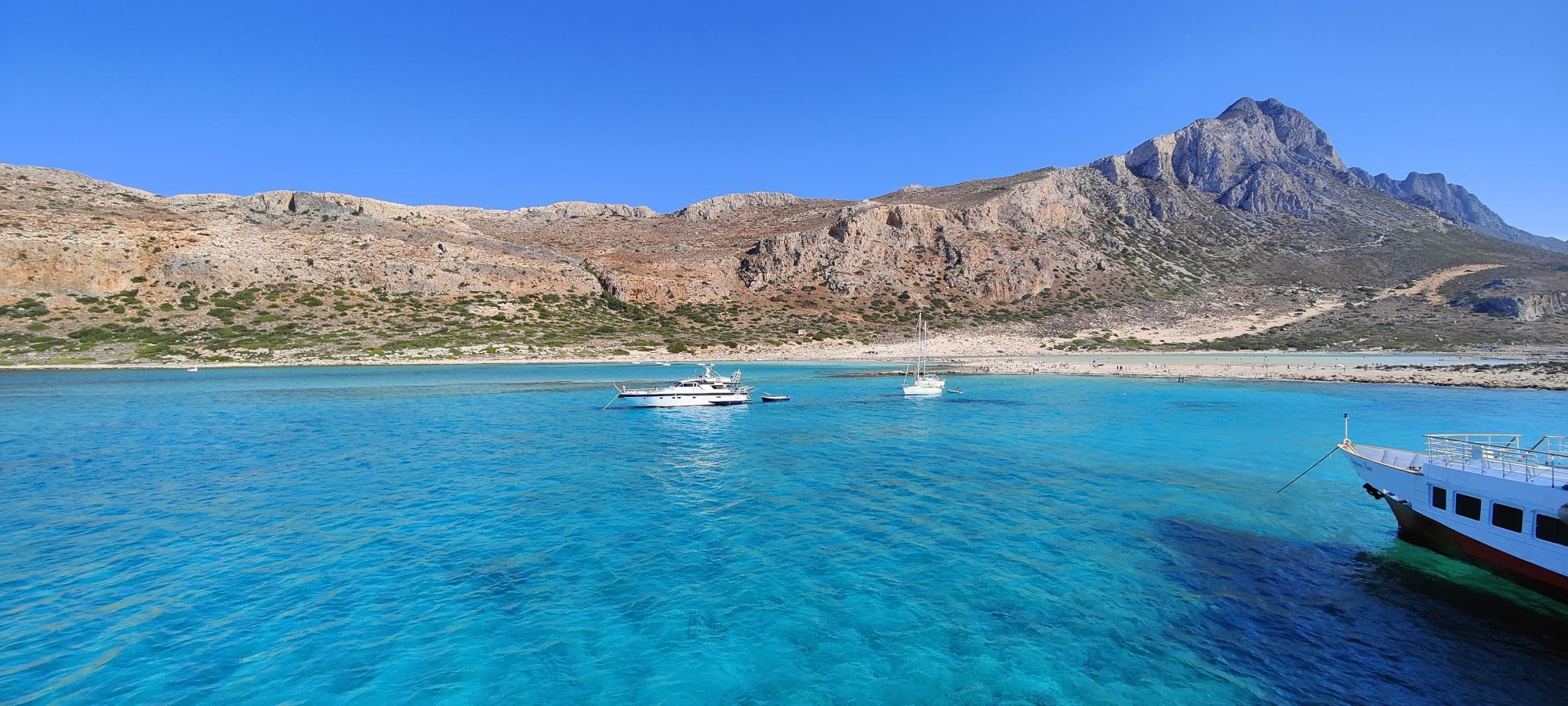
a daily excursion to the Balos Lagoon. A day at the sea!
The complete description of our itinerary and included services can be found here: Cretan Daily Cruises Website.
- Pick-up Point: In front of the Bank of Chania (Plus Code: G27F+Q8W Chania, Greece) at 09:00.
- Itinerary: Bus transfer to the port of Kissamos followed by a 7-hour cruise. It includes a stop at Gramvousa to swim or visit the Venetian castle, and a second stop at Balos Lagoon to enjoy the beach.
- Onboard Facilities: The boat has restrooms and a bar serving food and drinks (electronic payments only). No shops are available on the beaches, so please bring sunscreen, a hat, and sea essentials.
- Pricing: 35 EUR for the transportation ticket (bus and boat), plus an optional 10 EUR for the lunch menu. Confirmation and payment are collected on Sunday evening via CASH or REVOLUT transfer.
Registration
All available places have been assigned.
If you are still interested, you can register and, if eligible, you will be placed on a waiting list.
Participation for waitlisted candidates cannot be guaranteed,
as invitations and group assignments depend entirely on last-minute availability.
If you are interested, please write an email to as at elena.gaburro@univr.it and maria.kazolea@inria.fr, as soon as possible. In your message please include the following information:
- Name and surname
- Institution
- Name of your supervisor or a senior researcher you usually work with
- Current position: PhD student, Postdoctoral researcher, or more experienced researcher
- If you wish, you can attach a Curriculum Vitae
- Ordered list of your favorite projects
Selection procedure
Organizers and project leaders
will periodically check the list of interested participants.
We will maybe contact you to have some additional information and to confirm your interest in coming.
Then, taking into account the order of the received applications,
your preferences, and your background,
we will progressively assign the available spots within each group.
Already allocated spots: 30.
Applications to be evaluated : 0 (eligible and just to be assigned to a group) Applications evaluated so far : 40Waiting list: ...
Registration is free
Please note that the information provided below is provisional at this stage and will be finalized in May. Please also note that minor details may be subject to last-minute changes due to the time required for the research projects and to weather conditions.
Free registration includes:
- The welcome reception (drinks & light dinner) on Sunday evening
- Dedicated workspace at the Technical University of Chania
- 1 coffee break and 1 lunch per day for 4 days
- Private bus transportation at scheduled times on the route Chania – University – Marathi/Loutraki Beach – return to Chania
- Private bus service on the day of the social event (other expenses connected to the social event such as boat trip or food are not included)
- Partial reimbursement of project managers’ expenses in recognition of their effort and professionalism in preparing and managing the projects
Not included.
Note that accommodation and travel expenses for participants are not covered.
Moreover, participants are expected to bring their own laptop.
Projects and their leaders
Wasilij Barsukow
(CNRS, Université de Bordeaux, France)
Project:
New-generation Active Flux methods and their efficient implementation
We will develop new algorithms in the spirit of Roe's original Active Flux. The aim will be to simplify existing evolution operators and to extend this approach to new problems. Implementations will serve as a validation step, ensuring that the proposed methods run as intended and revealing any aspects that may require further refinement.
Availability: group complete, open waiting list.
Walter Boscheri
(CNRS, Université de Chambéry, France)
Project:
Exploiting moving meshes for involution preserving schemes
Keywords: plasma flows, unstructured meshes, divergence-free preservation, Arbitrary-Lagrangian-Eulerian.
Availability: group complete, open waiting list.
Giovanni Leidi
(Heidelberg Institute for Theoretical Studies, Germany)
Project:
Applying high-order structure-preserving finite volume methods to astrophysical applications
- There will be a shared core task:
implementing a higher-order (>=3) finite volume method suited for
modeling flows in stellar interiors.
- In addition, there will be more specialized tasks
(e.g. hydrodynamics, gravity, rotation, diffusive heat transport, boundary conditions and testing)
that can be tackled eventually separately by the team members, depending on their experience.
Availability: group complete, open waiting list.
Sandra May & Peter Munch
(Technische Universität Berlin, Berlin, Germany)
Project:
Hyperbolicity Meets Stochasticity
In this project, we will develop and implement numerical methods for solving stochastic hyperbolic conservation laws. To handle the stochastic components, advanced Monte Carlo techniques—such as multilevel Monte Carlo—will be employed. Participants are expected to have a background in numerical methods for hyperbolic problems, while only minimal prior knowledge of stochastic concepts is required (for example, familiarity with normal distributions and expected values). A central focus of the project will be investigating to what extent the discrete solutions of stochastic hyperbolic problems preserve key structural properties.
Availability: group complete, open waiting list.
Davide Torlo
(La Sapienza, Roma, Italia)
Project:
Equilibria preserving model order reduction methods for parametric problems
Keywords: Parametric problems, global flux methods, equilibria preserving, model order reduction, implicit methods, long time behavior, perturbations.
Availability: group complete, open waiting list.
Panagiotis Tsoutsanis - Takis
(Cranfield University, United Kingdom)
Project:
Exascale ready high-order methods
The focus will be on new formulation of existing methods so that they can perform on exascale hardware (CPUs+GPUs);
moreover, the project leader will make available some pre-exascale or exascale class systems to do test remotely.
Availability: group complete, open waiting list.
We will develop new algorithms in the spirit of Roe's original Active Flux. The aim will be to simplify existing evolution operators and to extend this approach to new problems. Implementations will serve as a validation step, ensuring that the proposed methods run as intended and revealing any aspects that may require further refinement.
Keywords: plasma flows, unstructured meshes, divergence-free preservation, Arbitrary-Lagrangian-Eulerian.
- There will be a shared core task:
implementing a higher-order (>=3) finite volume method suited for
modeling flows in stellar interiors.
- In addition, there will be more specialized tasks
(e.g. hydrodynamics, gravity, rotation, diffusive heat transport, boundary conditions and testing)
that can be tackled eventually separately by the team members, depending on their experience.
In this project, we will develop and implement numerical methods for solving stochastic hyperbolic conservation laws. To handle the stochastic components, advanced Monte Carlo techniques—such as multilevel Monte Carlo—will be employed. Participants are expected to have a background in numerical methods for hyperbolic problems, while only minimal prior knowledge of stochastic concepts is required (for example, familiarity with normal distributions and expected values). A central focus of the project will be investigating to what extent the discrete solutions of stochastic hyperbolic problems preserve key structural properties.
Keywords: Parametric problems, global flux methods, equilibria preserving, model order reduction, implicit methods, long time behavior, perturbations.
The focus will be on new formulation of existing methods so that they can perform on exascale hardware (CPUs+GPUs); moreover, the project leader will make available some pre-exascale or exascale class systems to do test remotely.
Advices
How to arrive
By plane
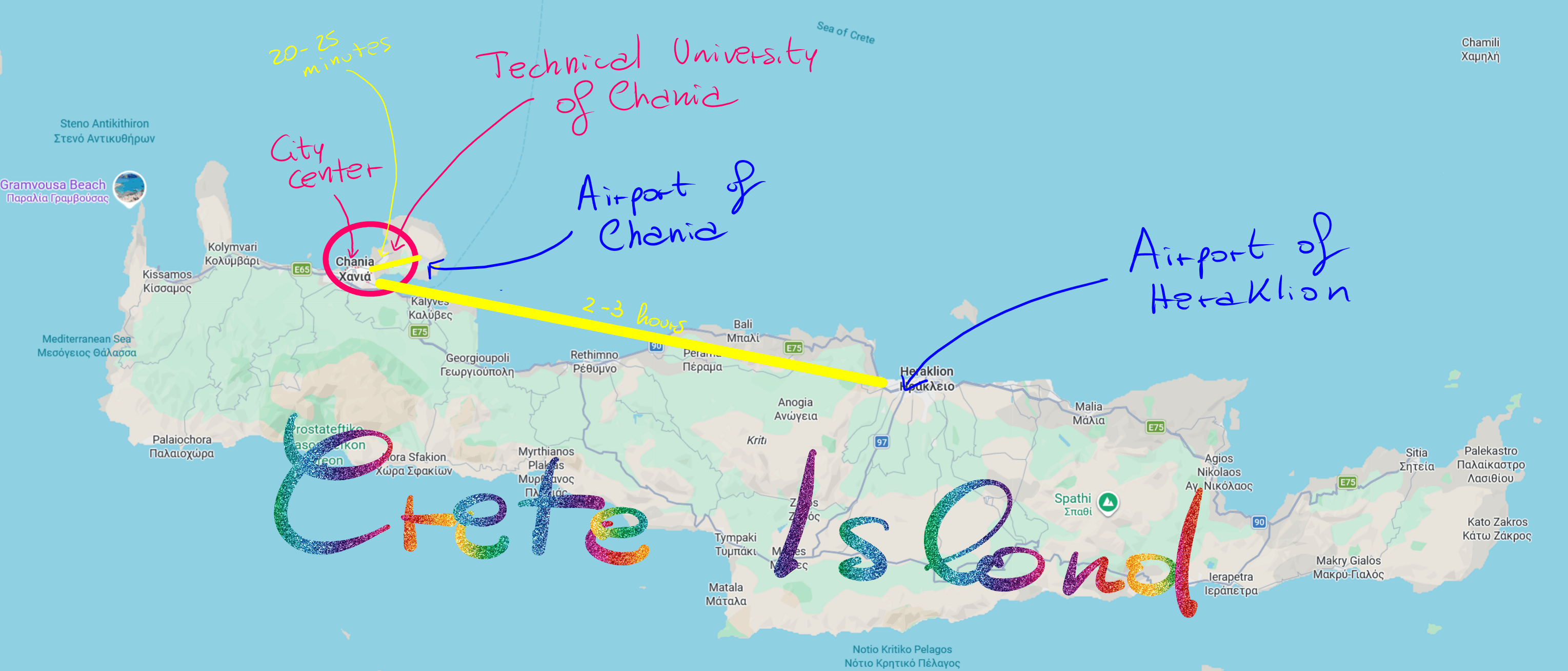
The closest airport is the Airport of Chania,
which is about 20–25 minutes by car or bus from the city center of Chania.
On the island, there is another option: the international
Airport of Heraklion,
approximately 2–3 hours by car or bus from the city center of Chania.
Where to stay
There are plenty of options (hotel and apartments) on Booking.com and Airbnb.com,
so we recommend having a look and choosing what suits you best.
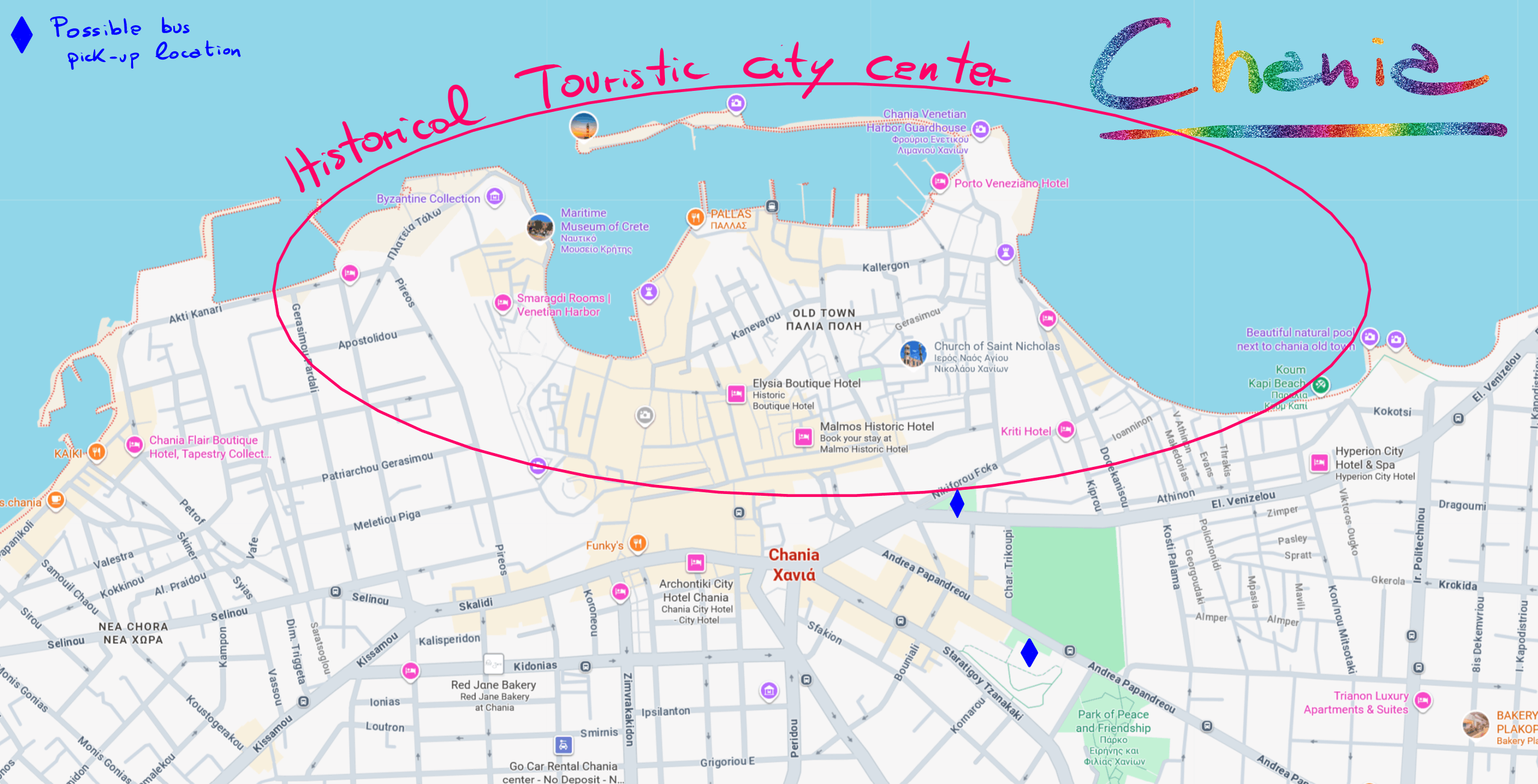
Below you can find a map of Chania's city center.
The most touristic area is highlighted by the red ellipse,
while the possible bus pick-up locations are marked with blue diamonds.
Hotel suggestions:
These hotel suggestions are just for reference, and we do not have any special agreements with them.
We have visited the properties but have not personally stayed there.
Kriti Hotel,
Hyperion Hotel & Spa,
El Greco Hotel,
Delux City Hotel,
Porto Veneziano,
Kumba Hostel.
 Where to go
(Work in progress – some links may be out of date - personal comments by Elena)
By walking:
Where to go
(Work in progress – some links may be out of date - personal comments by Elena)
By walking:
- Nea Chora beach, just a normal city beach, 25 minutes walking
- Archeological museum of Chania, 15 minutes walking
By bus:
- Urban bus: link to bus schedule in greek ... otherwise use google maps
useful buses are 11 to Nea Chora beach (just a normal city beach), 21 to Xrisi Akti - Agioi Apostoloi (closest nice beaches)
- Intercity buses (see the highlighted pdf for buses info): you can go to
Loutraki and Marathi (very nice beaches!),
Seitan Limenes (very nice, like a swimming pool, but may be crowdy and you have to climb a bit),
Almerida (very nice, but further away than the others)
One day trip (for going by bus see the pdf):
- Lagoon of Balos (light-blue-green see, fantastic colors!!!): go by (big) boats from Kissamos port (reserve boat tickets at least the day before)
- Elafonissi (light-blue-green see, fantastic colors!!!, no bar on the beach)
- Falasarna (amazing sunset, very sunny, with beach bars)
- Paleochora (it is a less touristic village with long beaches with blue-deep see)
- Paralia Menies (Elena: "I have never been here, but I will try to go this time ... there should be boats going there departing from Agia Marina")
Organizing Committee
Chair: Elena Gaburro (University of Verona, Italy)
Co-chair: Maria Kazolea (Inria Bordeaux, France)
Local organizers: Anargiros Delis, Anastasios Sifalakis & George Kokkinakis
(Technical University of Crete, Chania, Greece)
News
📅 The official program is now public! Check out the daily logistics and social activities below.
Sponsors




Contact Us
elena.gaburro@univr.it & maria.kazolea@inria.fr
The closest airport is the Airport of Chania,
which is about 20–25 minutes by car or bus from the city center of Chania.
On the island, there is another option: the international
Airport of Heraklion,
approximately 2–3 hours by car or bus from the city center of Chania.
Below you can find a map of Chania's city center. The most touristic area is highlighted by the red ellipse, while the possible bus pick-up locations are marked with blue diamonds.
Hotel suggestions:
These hotel suggestions are just for reference, and we do not have any special agreements with them.
We have visited the properties but have not personally stayed there.
Kriti Hotel,
Hyperion Hotel & Spa,
El Greco Hotel,
Delux City Hotel,
Porto Veneziano,
Kumba Hostel.
- Nea Chora beach, just a normal city beach, 25 minutes walking
- Archeological museum of Chania, 15 minutes walking
- Urban bus: link to bus schedule in greek ... otherwise use google maps
useful buses are 11 to Nea Chora beach (just a normal city beach), 21 to Xrisi Akti - Agioi Apostoloi (closest nice beaches)
- Intercity buses (see the highlighted pdf for buses info): you can go to
Loutraki and Marathi (very nice beaches!),
Seitan Limenes (very nice, like a swimming pool, but may be crowdy and you have to climb a bit),
Almerida (very nice, but further away than the others)
- Lagoon of Balos (light-blue-green see, fantastic colors!!!): go by (big) boats from Kissamos port (reserve boat tickets at least the day before)
- Elafonissi (light-blue-green see, fantastic colors!!!, no bar on the beach)
- Falasarna (amazing sunset, very sunny, with beach bars)
- Paleochora (it is a less touristic village with long beaches with blue-deep see)
- Paralia Menies (Elena: "I have never been here, but I will try to go this time ... there should be boats going there departing from Agia Marina")
Organizing Committee
Chair: Elena Gaburro
Co-chair: Maria Kazolea
Local organizers: Anargiros Delis, Anastasios Sifalakis & George Kokkinakis
News
📅 The official program is now public! Check out the daily logistics and social activities below.
Sponsors
Contact Us
elena.gaburro@univr.it & maria.kazolea@inria.fr